Our democracy will die unless Americans more loudly and aggressively organize and fight to keep it
September 2025
Green Valley, Arizona is a sleepy, fairly rural community 20 miles south of Tucson. It’s also fairly new to protests.
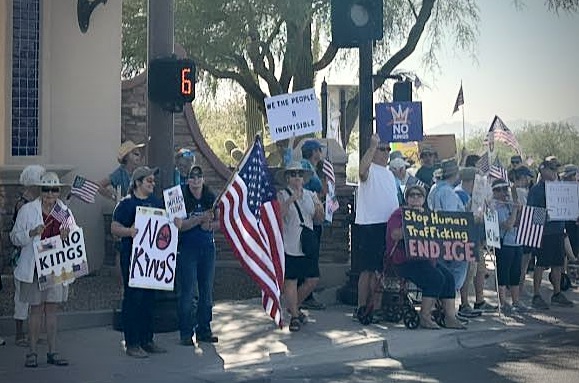
The last few months, motorists have been honking their horns in support of hundreds of Green Valley residents who’ve been rallying on neighborhood corners, displaying their disgust, disbelief and a desire to save our democracy.
The visible protests are a reminder to Americans that Donald Trump won the 2024 election with just 49.8 percent of the popular vote—hardly an overwhelming mandate by “the people.” They’re outraged that Trump is lowering the bar of basic civility, rewriting history, violating basic constitutional rights, and essentially orchestrating the demise of our democracy—while simultaneously hoping to remain as some kind of fascist dictator.
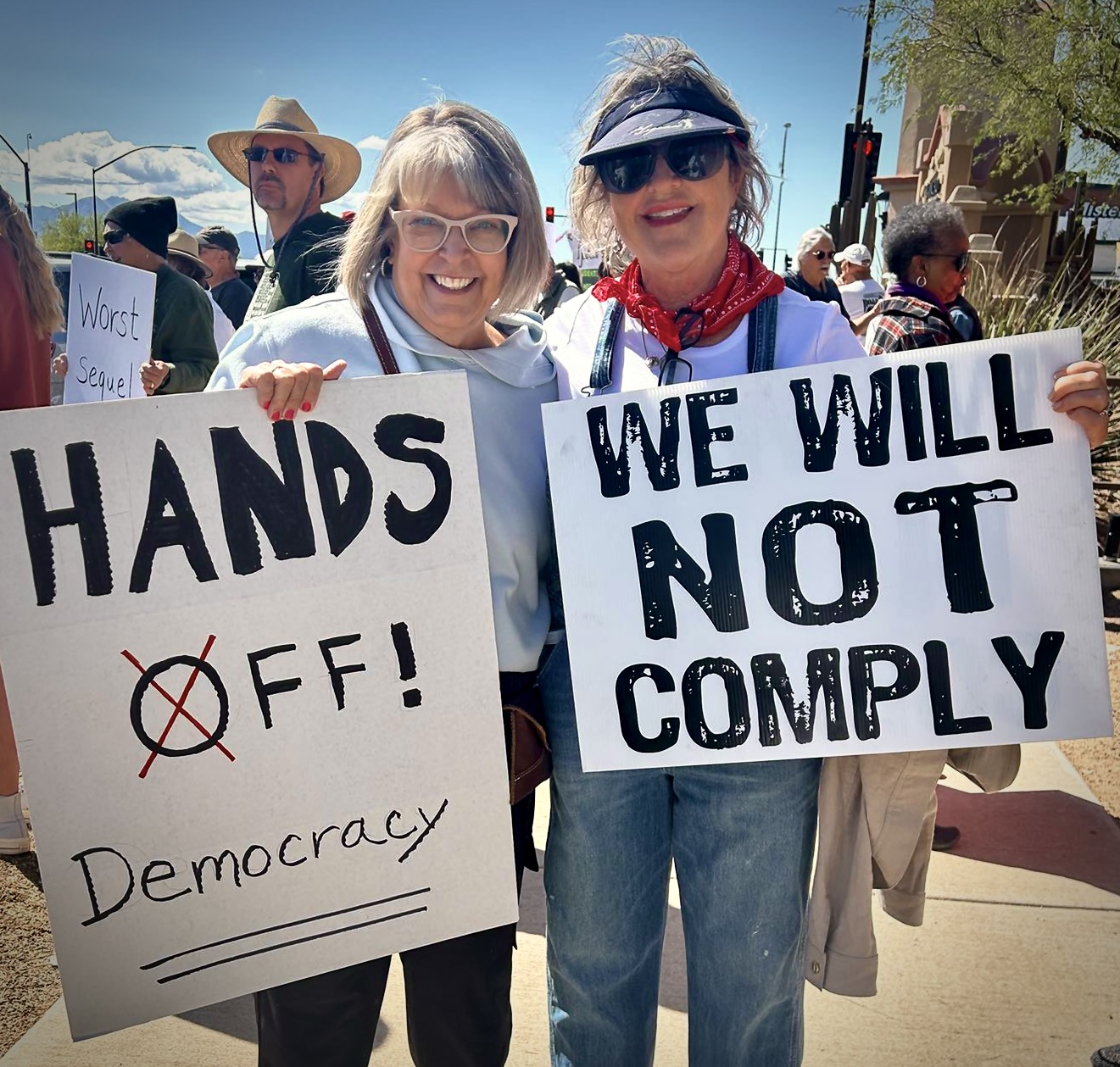
Mary Alice O’Connor (right) and her friend, Joyce Smerick, protest in Green Valley, Arizona. Summer 2025.
Green Valley police say that routine weekend rallies—with Trump supporters on one corner and those urging “No King” on three other street corners—have at times “been rowdy.” But peaceful. The cops make their presence known “just in case,” to ensure the differences of opinion stay civil.
These Green Valley protests are tame compared to my prior community of Madison, Wisconsin, a liberal bastion where protests are as common as mosquitos.
Green Valley is different in other ways, too.
A few months ago, several people in my retirement community here sat around a kitchen table and agreed that they all felt helpless, powerless and invisible. But they also said, “We simply can’t stand by and watch Trump ignore the Constitution, gut due process, try to own our courts, and mock basic human rights. We must do something. We just aren’t sure what.”
So, they agreed they would each contact six of their Green Valley friends and neighbors via email and invite them to a meeting to figure out “what can we do and where should we go from here?” They hoped a dozen people would show up.
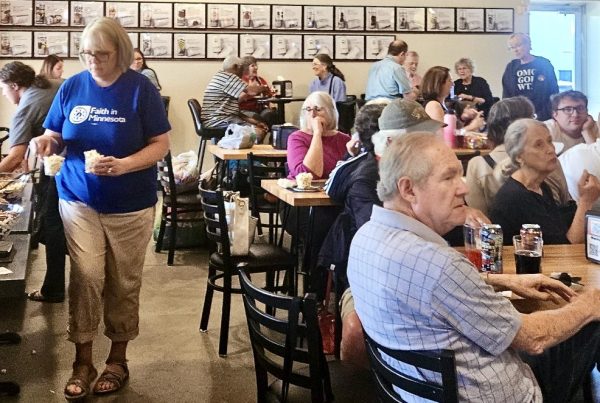
Instead, the 24 emails they sent resulted in word of mouth that rallied a crowd of more than 550 people. Including me. The organizers were stunned.
On the day of the meeting, we all tried to jam into a tiny community meeting room that had been reserved. We ran out of chairs, space, and doorways. The line of people wanting to get into the room stretched down the sidewalk, with people straining to hear what was being said inside the room.




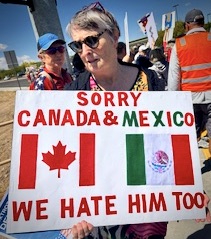
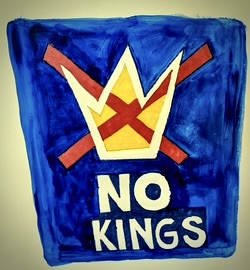
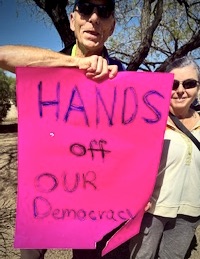

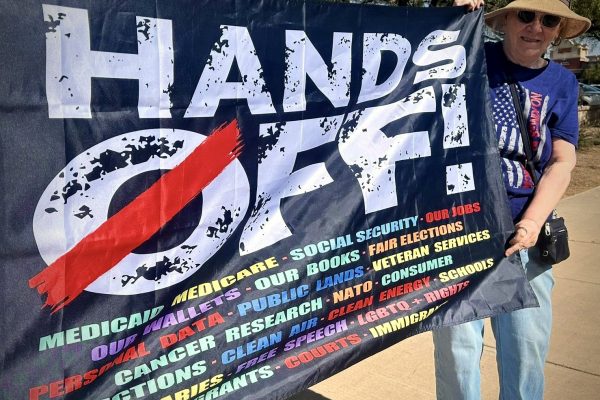
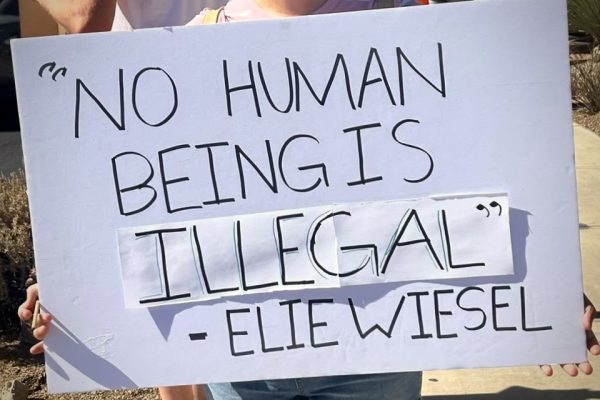
This crowd was motivated. The overwhelming sentiment: “We can’t wait for the remainder of Trump’s term, or until the midterms. We will lose our democracy by then. We will not and must not be silent.”
Two people who spoke up that night identified themselves as lifelong, but now disgruntled, Republicans. People clapped for them. In years past, they might have been booed. They said they’d come to this meeting out of curiosity. They said Trump’s “rule” is no longer a Democrat or Republican issue. “He’s gone too far,” they said. “He swore he would uphold the Constitution, but he has not. We middle-of-the-road Republicans don’t have a party anymore. That’s why we’re here.”
Again, people clapped. The theme of country over party resonated with everyone in attendance. At the end of the meeting, three groups were formed on separate clipboards: Action, Organizing and Communication. The Action group was tasked to identify other areas for visible demonstrations, letter writing, and meetings to engage others. The Organizing group was set up to find future speakers for different events.
The Communication group was assigned to write to the media, to contact the Arizona Congressional delegation and others, and to seek out new ways to become visible in defending our democracy.
The four organizers of the meeting were quick to say these grassroots groups would be nonpartisan, with one goal: “Save our Constitution and democracy.”
As we adjourned, one of the Republicans in attendance also urged everyone to go to the next public appearance of our congressman, District 6 Republican Juan Ciscomani.
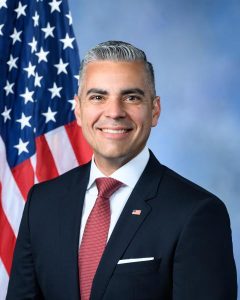
Arizona Congressman Juan Ciscomani, from his website
I took his advice and went, eager to meet my new representative in Congress. I thought it’d be a great opportunity to ask him about his position on the issues I cared about.
But it didn’t happen.
Before Ciscomani arrived, the local GOP chairman who hosted the meeting told all 200+ of us in the audience—a packed room—that “we should know the Congressman’s busy schedule would not give him time for any questions after his prepared comments.” Ciscomani arrived through the back door, avoiding protestors at the front gate.
Just as Republican leaders have told their rank and file to stop having in-person town halls so that they don’t have to explain their votes, the format of this meeting was out of the same playbook.
Police stood at the front of the room, a physical reminder that any unruly behavior from disobedient audience members would likely result in removal. Photos of this event would make it seem like he was presiding over a packed room of orderly constituents, all of us intently listening to his every word.
Ciscomani gave a friendly, very noncontroversial speech. He emphatically said there would be absolutely no cuts to Social Security and Medicare. At the same time, he failed to address the impact of office closings and staff cuts that have been making it impossible to get services out of a federal agency. He ignored the impact that changing definitions would have on many elderly, blind and disabled—making them ineligible for many safety net programs going forward.
The congressman avoided discussing pretty much all of the issues that many, if not most of us in attendance, came to hear about. Near the end, one audience member stood and attempted to ask a question but was stopped by several (I assume) Ciscomani staffers who surrounded her and insisted she sit back down. Ciscomani saw it happen and chose to ignore the woman.
I sat there too, silently seething.
On paper, this two-term congressman seems like a dream Republican candidate. An immigrant himself, his father a bus driver, Ciscomani worked a variety of odd jobs before he became active in the Tucson Hispanic Chamber of Commerce. He’s articulate and polished—a very smooth talker. During his 20-minute speech, he informed us about such important issues (sarcasm alert) as the sale of vacant federal office buildings netting $10 billion for taxpayers.
Did he forget where he came from and who his constituents are?
I’ve since learned that getting access to Ciscomani is almost impossible. My congressman, who represents parts of Tucson and all of Green Valley, prefers you only contact him via his voice mail, even if he’s standing right in front of you. I’ve left several messages with both his Tucson and Washington D.C. offices but have never heard back from him.
I’m not yelling in these messages. I’m respectful. “Hi, this is Alice,” I say. “I live at…and I’m your constituent calling about…Can you please call me back? I could really use your help. My number is…”
In Madison, it didn’t matter if I called my congressman’s local office or D.C. office. I always received a call back, even if it was only from an intern. I’m not even sure Rep. Ciscomani’s staff is listening to his voice mails.
I really do need help. My 35-year-old, cognitively disabled, adult daughter—who has no income—is suddenly no longer eligible for Medicaid, a program she’s been on since she was 21. I desperately need for her to receive this minimum health care coverage. I’m now paying cash for her health care services that were previously paid by Medicaid for the past 5 years.

Mary Alice O’Connor and her daughter, Signe
The communication I’ve received from the Arizona Health Care Cost Containment System (AHCCCS) claims she’s over the “income limit,” even though she has no assets and currently has no outside employment (and therefore no income).
AHCCCS has denied her eligibility to continue the Medicaid coverage she received in Wisconsin, even though her Social Security Disability Income (SSDI) is below AHCCCS’ one-person income limit of $1,735 per month.
One hundred percent of my daughter’s SSDI check goes to defray her food and rental costs at her assisted living facility, but she still has medical care needs that are no longer covered.
How can someone with no paycheck and no assets be ineligible for Medicaid when their (lack of) income falls under the state’s income limit? I’ve sought help everywhere, invested hours into finding an answer, and been transferred from one government agency to another. I remain in limbo.
Rep. Ciscomani’s unwillingness to return my many calls and messages alone would make it seem like he doesn’t care what happens to my daughter and others like her who depend on Medicaid for their health care (she’s also now an Arizona resident, too). But he also voted to support the Medicaid cuts proposed in Trump’s budget—cuts that will now impact thousands of elderly and disabled people in his district and throughout Arizona and the nation.
Given his vote, I thought he might have some insight as to what I’m supposed to do now.
Ciscomani has also supported funding cuts to public education and special education, even though federal law guarantees an education to students with special needs through age 21.
If my new congressman never acknowledges my call, can he then say, “I didn’t realize Medicaid cuts were an issue for my constituents?” If a tree falls in the forest and no one is around, is there no sound?
While Ciscomani and other House Republicans enjoy a yearly $175,000+ salary, a great pension, premium health insurance benefits for themselves and their families (along with access to care), I now worry for the disabled and senior citizens who might end up homeless or die because they won’t be able to get any medical care.
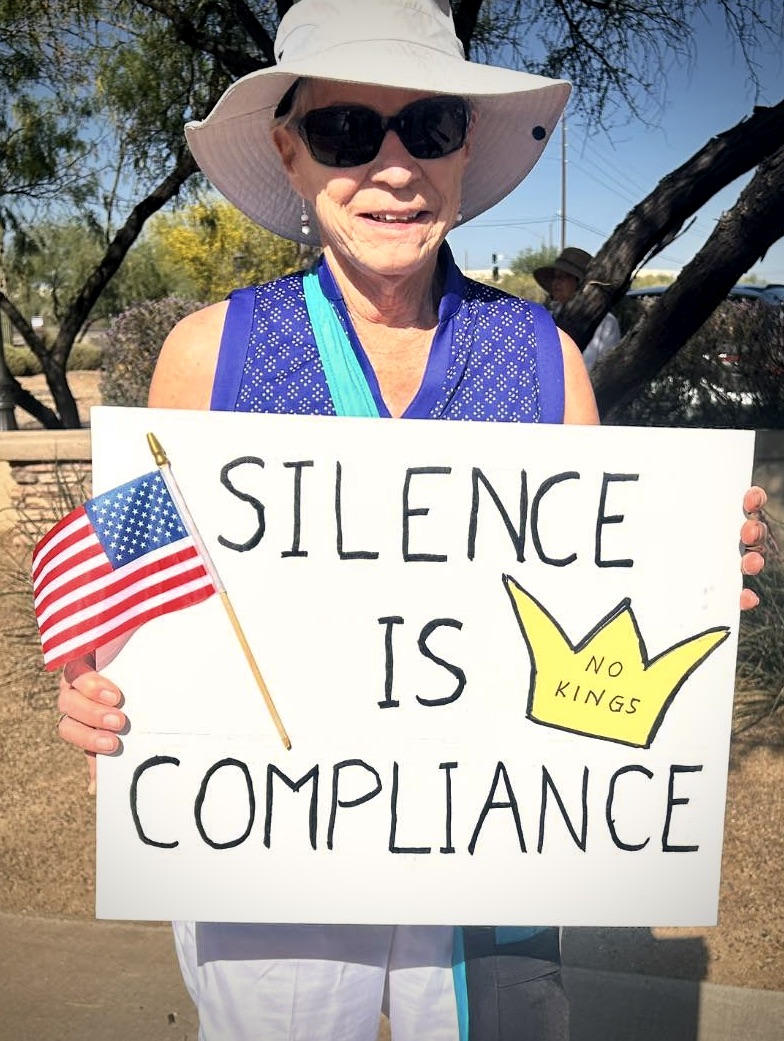
More scene from the protests in Green Valley, Arizona.
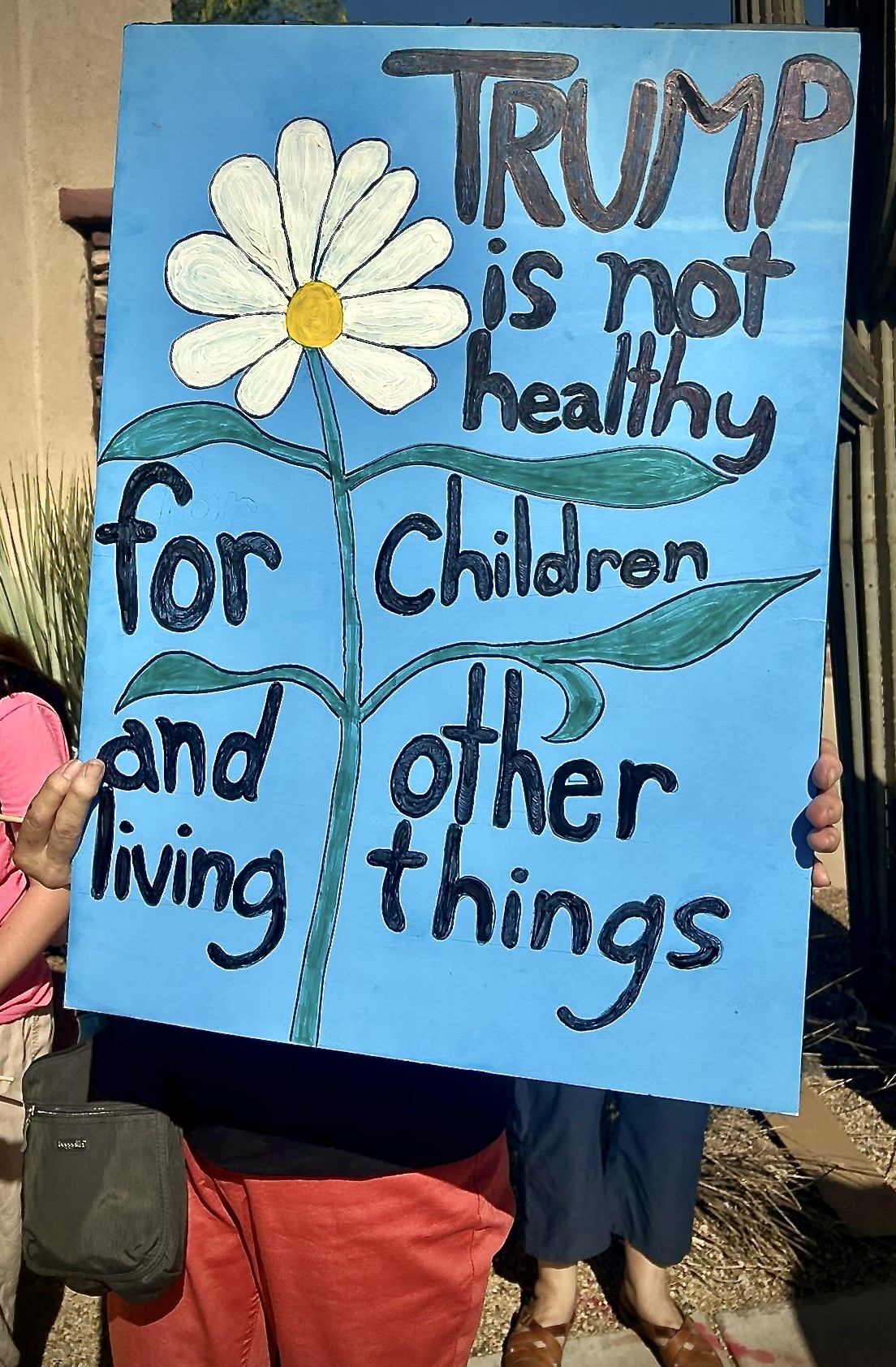

In 2023, the median household income in Green Valley was $58,268, a slight increase from the previous year’s median of $57,785. The average hourly wage in my Arizona county, Pima, is $23 per hour with a high of $36 per hour. Does Rep. Ciscomani, who makes three and four times more than his constituents, now feel an overinflated sense of his self-importance?
Why does he feel he must support Trump and his skewed policies—policies that will hurt his own constituents while protecting the one percent of our wealthiest citizens?
I’d like to ask him.
Still, Ciscomani’s nonresponse hasn’t kept me as invisible as he might hope.
On a recent summer day, we Green Valley retirees took to our street corners to protest again and were greeted by hundreds of passing motorists who took the time to honk even longer and louder in support of our efforts.
Green Valley itself is certainly not a hub of liberal politics. The average age is 74 (I’m 71), with many retired people of different political stripes living here. But we showed up. For our children and grandchildren, if nothing else. People in neighboring Sahuarita, a community comprised of younger middle class working families, showed up to protest, too. They’re anxious about cuts to education, Medicaid, and the overreach of ICE in a predominantly Hispanic part of the state that borders Mexico.
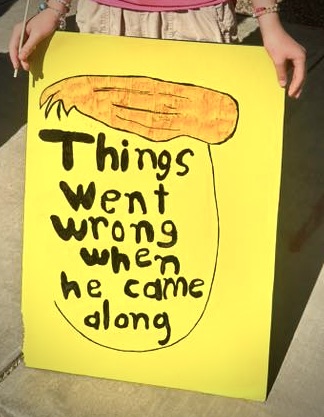
I met a young girl who had skipped her soccer practice to come and stand with us, with her own sign. She told me she wanted to be informed, so that she could then tell others of her generation how critical the issues are.
I told her she should consider running for office herself one day. “Really?” she said, smiling. “You think I could?”
I smiled back and told her, “I look forward to seeing your name on the ballot. I’d vote for you.”
I thanked her dad for bringing her.
I used to believe protests were somewhat ineffective. But I’ve changed my mind.
While the Republicans in Congress renege on their own duties to hold our president in check and uphold the Constitution, frequent visible protests in their congressional districts, and in communities of all sizes across the US, should have them nervous about their own re-elections in November 2026.
During the Rep. Ciscomani speech I attended, my Republican congressman told us that our congressional district consists of three almost equal constituencies—one third Republican, one-third Democrat, and one-third either independent or undecided. With that explanation, my math conservatively now concludes that two-thirds or more of Ciscomani’s constituents aren’t very happy about where his leadership, Trump’s leadership, and this country, have taken us.

Joyce Smerick and Mary Alice O’Connor return for another “No Kings” protest in Green Valley, Arizona. Summer 2025.
The U.S. Constitution dictates our framework of governance, and people have died for these principles of democracy. But in order to keep our way of life, we can’t just “resist.” We need to fight.
It’s time for more grass roots planning, more mass protests, and a collective American awakening.
Mary Alice O’Connor is a Reporters Inc. Board Member. You can read more about her here on our Team page. She can be reached at aoc@constituencyservices.org
The Reporters Inc. is a proud member of the Institute for Nonprofit News, a consortium of more than 500 nonprofit newsrooms dedicated to serving the public interest. Our articles are syndicated and shared with hundreds of other media organizations, online magazines, top blogs, etc. Please send news, feature and investigative story tips and ideas to info@thereporters.org.